How a Counterfeit Money Scheme Led to a Downfall in Colorado
Derek H. thought he had an airtight plan to turn counterfeit $100 bills into real money. The darknet marketplace promised flawless fakes, but reality had other plans.
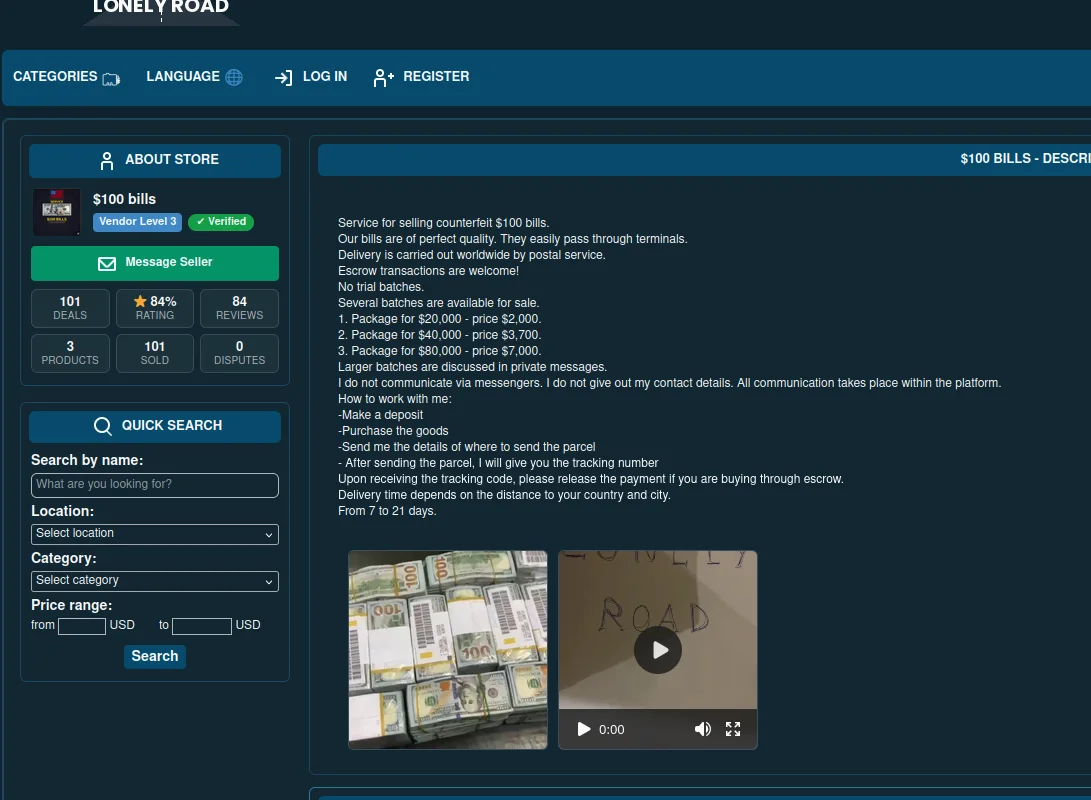
What looks like a foolproof way to exploit a bank’s ATM can quickly spiral into a federal case. In January 2025, Derek H., a 29-year-old from Denver, spent $1,200 in crypto on a darknet market to buy 40 fake $100 dollar bills—2009 series, with watermarks, magnetic strips, and UV protection. The seller advertised them as 'superdollar quality,' a term often used for near-perfect prop money dollars that even banks might overlook. His strategy was simple: deposit the fake money dollar bills into a cash-accepting ATM, let the machine credit his account, then withdraw or transfer the funds as legitimate. The first two machines accepted $800 without issue, but the fourth transaction triggered a review—and three weeks later, the U.S. Secret Service arrested him.
Key takeaways
Banks detect fake $100 bills quickly using advanced sensors and serial number tracking.
The fake dollar price of $30 per note was not enough to evade detection.
Authorities traced Derek’s fake money darknet purchase in three weeks.
Even high-quality fake money dollar bills leave digital trails.
The U.S. Secret Service prosecutes counterfeit money cases aggressively.
1. The scheme unravels at the ATM
Why did the bank detect the counterfeit $100 dollar bills so quickly? Most ATMs use advanced sensors to verify authenticity, but they’re not infallible. Derek’s first two deposits went through because the machines focused on visual checks and basic security features. However, the third ATM rejected a bill, and the fourth flagged the transaction as suspicious. Banks cross-reference ATM activity with customer profiles, and a sudden influx of cash—especially in high-denomination fake 100 dollar notes—raises red flags. Once flagged, the bank froze Derek’s account and initiated an investigation, tracing the source of the funds to the darknet marketplace where the purchase was made.
2. From search to arrest in three weeks
Derek’s plan hinged on the belief that the fake dollar price and quality would pass scrutiny. At $30 per note, the prop money for sale nearby on the darknet seemed like a bargain for such realism. Yet, banks employ layered detection systems, including serial number tracking and ink analysis, which can identify even the most sophisticated counterfeit $20 dollar bills or fake 100 dollar notes. Authorities, tipped off by the bank’s fraud detection, linked Derek’s activity to the marketplace. The U.S. Secret Service, which oversees financial crimes, moved swiftly—his arrest came just 21 days after the first deposit. The lesson is clear: even the best fake money australia or buy fake dollars operations leave digital traces that can be followed.
The cost of a counterfeit dream
The case of Derek H. shows that the allure of quick money through fake money sites or darknet purchases is a high-stakes gamble. Banks and law enforcement have systems in place to detect even the most convincing counterfeit bills, and the consequences are severe. Whether it’s realistic fake money or a single counterfeit $20 dollar bill, the risks far outweigh the rewards.
Questions readers ask
- Can ATMs detect fake 100 dollar notes?
Yes, most ATMs use UV, magnetic, and ink verification to flag counterfeit $100 dollar bills, though some may initially accept them before a review.
- How much does prop money for sale nearby on the darknet cost?
Prices vary, but Derek paid $30 per note for 40 fake $100 bills, totaling $1,200 in cryptocurrency.
- What happens if you buy counterfeit 20 dollar bills online?
Using or attempting to pass counterfeit $20 dollar bills is a federal crime, and law enforcement can trace the purchase back to the buyer.
- Are there realistic fake money sites?
While darknet markets may advertise realistic fake money, the risks of arrest and financial loss are extremely high.